Tuesday, July 28, 2020

Garden Journal: July 2020

I've always had good intentions of keeping a garden journal. I read memoirs like Animal, Vegetable, Miracle or Garden Wisdom: Lessons Learned from 60 Years of Gardening and imagine the treasure trove of journals the authors must have drawn from. Any garden journal I've kept doesn't make it past a few entries. This blog is the closest thing I have to a journal. I need to stop imagining a journal as a physical book that I write in every day or every week. The concept of journaling is to create time to reflect and remember events in the future. My blog, camera roll, Instagram and Facebook accounts, and garden planning software serve that function in aggregate. I've given myself permission to be a good gardener without a garden journal.

Today was different. I have the week off from work, and my intention is to spend most of my time in the garden, the kitchen, or with my nose in a book. This morning, after a cup of tea and a peach scone baked from scratch, I brought my second cup of tea out to the garden and unfolded a camping chair. I just sat and looked at things. When the carrots or rutabagas were just screaming to be thinned, I obliged. I pulled a few weeds. I propped up a leaning pepper plant and harvested a few ripe tomatoes. I kept noticing things I wanted to remind myself of next year, now that I'm 8 weeks into the first season of gardening in an open canvas of dirt, rather than raised beds or designated planting holes through fabric as I have for the last decade. I came up with quite the list, from the practical to the philosophical. I'm documenting it here for future reference, and for any unintended benefit to aspiring or current gardeners who stumble upon this post.

The Garden As A Living Space

A garden is a place to relax (or work hard) and enjoy my home. Space left open for paths or to give veggies room isn’t wasted; it’s prioritizing the garden as living space. For years I tried to maximize my yield per square foot, sometimes planting raised beds in the square foot gardening method. I only planted corn once (it was a failure due to strong storms, animals, and general neglect) because I couldn't justify just two delicious ears of corn per stalk. What was I thinking, that's the perfect amount for dinner! Prioritizing for yield may mean minimizing enjoyment. My garden is not intended to be a second job.

The shade tent is amazing for working on hot, sunny days, but it’s cumbersome for one short person to move around, especially because the legs dig into the ground. Perhaps we could put some tennis balls or something on the bottom of the legs to make it easier to drag?

Spacing: Never Trust An Ambitious Gardener


  • 18”-24” spacing for peppers is perfect. Consider adding a support pole right away, and tying plants to poles about 6 weeks post transplant. Don’t wait for them to fall over. Treat them nicely. 
  • GIVE THE DETERMINANT TOMATOES MORE SPACE. 18” apart is not enough. It creates a tangled mess, increases chances I miss ripe tomatoes, and makes harvesting more unpleasant since my skin reacts poorly to tomato leaves. Plant them 2’-3’ apart next year. So far, yields are amazing. I may not need to plant 20 plants next year. TBD. 

  • Although the winter squash do just fine direct seeded in a hill, I need to commit to removing seedlings so I have the quantity I planned for. This year I didn't do that, and I'm curious to see if it will yield to overall smaller squash. They do really well in my garden both up free-standing trellises and on the ground. If I continue letting them spread on the ground, I should mulch heavily with cardboard and straw or grass right after planting so I don’t have to worry about that area for the rest of the season (other than the hills).

Spring Reminders


  • Never put off mulching. Mulching makes everything grow better, makes maintenance easier, and it’s pretty! When planting rows of direct-seeded vegetables, consider mulching first, and leaving space where the rows will be. That should motivate me to still plant on time but the mulching will be done!
  • I’ll probably never regret under planting seeds (more room to grow, larger/healthier plants) but I will regret over planting them because of the extra work of thinning, less room for air to move when harvesting, etc.
  • It’s a good idea to seed radishes in with carrots, but do so sparingly (no more than 1 per foot) and only with the quickest growing varieties. This makes more sense to me than planting a dedicated row of radishes, because they’re not my favorite vegetable. 
  • It’s probably worth the tedium to create carrot seed strips or mats for planting, and always best to use seed that’s 1-2 years old. Old carrot seed doesn’t seem to fade as well as other varieties. Old beet, rutabaga, and chard seed does just fine though. 
  • Begin watching indeterminant tomatoes to prune suckers immediately. If I let one go so long it becomes a stem with blossoms on it, I won’t have the heart to prune it and I’ll regret it by July or August. Commit to tying the tomatoes to their stakes once a week whether I think they need it or not. If I continue to grow cherry tomatoes up rebar, I need to plant more (assuming I’m limiting them to a single vine). As my garden expands, I may want to consider planting them in some sort of container where 3-4 vines would be allowed to develop and drape over the sides.
  • Chard works just fine direct seeded in my garden. Kale is more challenging that way and should probably be transplanted.
  • The 8-ball zucchini grows straight up and puts out climbing vines. While it’s doing fine in hills, it would probably do well in a row in front of a trellis. 
  • Direct seeding basil was a bust (possibly because of old seed but I suspect because of inconsistent moisture). Definitely start these indoors for transplant.


Early Summer Reminders


  • Thin beet greens at 4 weeks for greens only, 6-8 weeks for baby beets (but the latter is probably slowing down growth of the main crop). Remember- they put out more than one seedling per seed by nature. It’s ok to space them generously when planting.
  • If critters eat my beans plants, replant promptly. They’ll catch up quickly (missed opportunity in 2020).

If anyone else is reading this, what has your garden taught you so far this year? What mistake do you seem to keep making year after year?

Monday, July 27, 2020

Harvest Monday: First Tomatoes of 2020

The garden is looking lovely, although honestly I feel like I've been neglecting it since I'm only out there a couple of times per week. My plant selections anticipated that behavior, so I think it should be ok. On Monday (no photo) we harvested our first full-size green sweet pepper, some basil and a single Sungold tomato, which tasted like heaven.

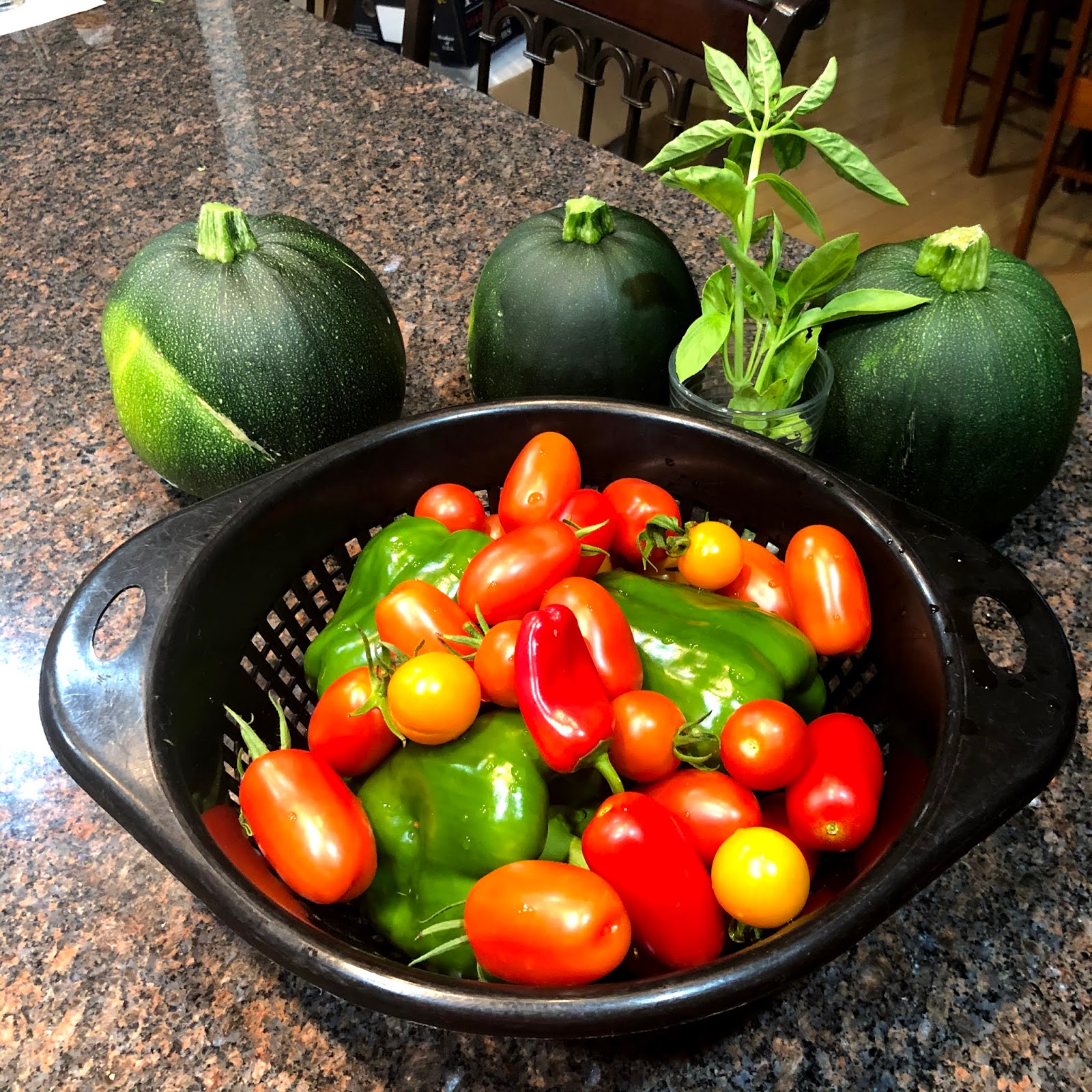
On Sunday night I stepped into the garden before a strong rainstorm and harvested two 8-ball zucchini (which went with a third we'd harvested on Monday), three more green sweet peppers, a bright red Yum Yum pepper, and a few unexpected handfulls of Juliet tomatoes, along with more Sungolds and the first Sweet 100s. Getting tomatoes before the end of July here is a real treat. I'm sure I'll be drowning in tomatoes before long (I have 20 paste tomato plants, two cherries, and two slicers).

Two of the peppers and all three of the zucchini were immediately used for dinner. I stuffed the zucchini with a mixture of onions, peppers, cooked radish and kohlrabi greens, black beans, brown rice, Penzey's fajita seasoning and shredded cheese. We have lots of leftovers; each of us ate about half of one and an ear of sweetcorn from our CSA.

basket of vegetables on a countertop


round zucchini stuffed with bean and rice mixture

I'm also getting a CSA this year, so that's where a lot of our veggies come from. We've been rolling in the greens though, because in addition to the CSA I've been pulling radishes from the garden and trying to use their leaves, and I've thinned just one row of beets (I have 4 more to go) and used the greens in a variety of dishes. I tried my hand at fermenting radish greens for about a week and used them in fried rice. The beet greens mainly end up in egg dishes and pastas. The reason I had leftover cooked greens to put in our stuffed zucchini was because I cleaned and chopped all the radish and kohlrabi greens we had and put them on a pizza. Using a store-bought crust, I used basil pesto for sauce (I found the pesto—from 2014—buried in the freezer and it still tastes fine), then piled the pizza with greens, mozzarella cheese, more greens, and then curls of zucchini tossed in olive oil, salt, and pepper. Finished it off with some fresh basil from the garden. We'll definitely make this again. (I was inspired by this recipe.)

Pizza topped with curled zucchini and basil

I took some garden photos on July 5, before I'd finished most of my mulching. These are three weeks old now, but they'll help establish the layout of my barden.

In the foreground of the first photo (past the weeds) from right to left is: melons (Minnesota Midget and Banana), beets (pre-thinning), rhutabaga (pre-thinning), and some irregularly seeded rows of carrots with radish markers.

On the opposite side of the black path on the right are my determinant tomatoes (20 plants), and on the left is my pepper patch (both sweet and hot), and some fledgling kale and sweet chard seedlings (that are doing much better now).

vegetable garden


From another point of view, you can see the four determinant tomatoes climbing up rebar, with the rhubarb plant behind them. To the right of the tomatoes is a small basil patch, and moving right from there is fennel, celery, zucchini, and winter squash (Red Kuri and Waltham Butternut).

vegetable garden with house in background

This post is a part of Harvest Monday, hosted by Dave at Happy Acres. Head over to his post to see what gardeners around the world are harvesting.

Saturday, May 16, 2020

Perhaps the Pandemic Will Prompt More Gardening

It's funny and also a little sad to look at my last post here, from May 2017. We worked our tails off and got those beds in, then spent a small fortune on what was supposed to be really high quality garden mix with a high percentage of compost to fill them. Then we had two main problems:

  • It was just too wet down there. We never were able to fill in around the beds, and it basically became a mud pit. The beds wanted to start rotting almost immediately.
  • Something was wrong with the garden mix, and it stunted almost everything planted in it. My guess is the compost in the mix was still "hot."
I did have a great upper garden that year, though. I covered the entire 800 square feet in black landscape fabric, and created holes in it to plant. I had bumper crops in both 2017 and 2018, although controlling the weeds up there is an ongoing challenge (that's why I went with garden fabric).
large space of ground covered in black landscape fabric, with holes created for plants. In the foreground, tomatoes grow on stakes.
The garden in 2017 (June) making good use of plastic lawn fabric
wheelbarrow filled to overflying with squash, peppers, cabbage, and other fall vegetables
Harvest from one September day in 2018

2017 was the beginning of a few years that threw us a lot of curveballs. In June 2017, my dad had serious surgery for an aneurysm. He's fine, but he was in ICU for awhile. My father-in-law passed away in November 2017, very unexpectedly. A few months later we found out my mother-in-law had cancer, and she died in August 2018. This was of course a lot of personal stress, but things were also busy on the work front. In fall 2017 I started a business! It's kept me very busy, and now there are 11 people on my team.

Because of that, I was traveling a lot—close to 100 days a year in 2018 and 2019, with a lot of that travel during the growing season. After seeing how the garden was getting away from me in 2018, we made the conscious decision to take 2019 off from gardening. So we did. We also hired landscapers to rip out our back patio and build us a gorgeous new patio and fire pit, and at the last minute decided to have them rip out that nasty mud pit and the retaining well near it, instead sloping our lawn directly to the pond. While digging the base of the patio, they found a huge drainage problem and had to install a new drainage system... it's no wonder we had a mud pit down there.
picnic table on brick pavers, then lawn extending to a pond. Farm in the background.
Part of the new patio, with a slope right into the pond

I thought 2020 might be another no-garden year; travel didn't seem to be letting up and the business continues to grow. Then, in mid-March, travel stopped and I (along with my entire team) started working from home full-time. We'll be working like this until at least July 1, and likely some sort of hybrid home/office situation after that. All of my work-related travel has been cancelled until at least late September.

So why not garden? I didn't start any seeds, and most of my preferred suppliers were sold out when I checked their websites in March/April, so I gladly supported a local greenhouse to get tomato and pepper seedlings, along with a few others. I've started the process of "waking up" the upper garden, where I plan to plant some veggies I don't get a lot of in my CSA, as well as the food we love to preserve. I should have the time.

But once again, it's back-breaking work. It took me two weekends of intermittent work just to make sure I had the asparagus patch ready for it to appear this spring (it just started).
straw-covered bed in front of a fence with a sign that says "asparagus"
Asparagus bed, just before spears started popping up

I spent this afternoon and early evening in the garden as well. I pulled up all the landscape fabric, and I've been digging out some perennial weeds. I'll till within the next couple of days (when I get a dry day), and then I want to try creating some planting areas that rely more on mulch (newspaper + straw for large plants, shredded paper/straw for small), rather than messing around with the fabric over the entire garden. That gives me the flexibility to plant things like rutabaga and bush beans, which wouldn't have worked in my last setup. I still have some of the landscape fabric, so I'll probably use it for rows (and it will be easier to re-use that way).

Because I've been working so much and our summer vacation (and probably fall) is cancelled, I also have a lot of time off piled up. So I'll have 3 and 4 day weekends the next few weeks to get the garden going, and entire weeks off (or days available for impromptu time) when the harvest and food preservation needs are greatest. Even if I'm sore for days, being in the garden makes me happy and allows me to forget everything else that's going on in the world. I'm glad I can focus on it this year.

Monday, May 1, 2017

A Very Muddy Work Day

What happens when you have just one day set aside to rent a sod cutter to get ready for your raised beds, and it rains for days and days before that? Lucky for me, I now have this experience and can answer the question.

  1. The sod cutter wheels get caked with mud and fail to grip, so it requires some man-handling.
  2. The sod is much, much heavier than it would be if given a few days to try out.
  3. Carrying the sod to its resting place for composting turns your husband into Mud Man.
Aaron completely covered in mud, thumbs up
I just pulled these clothes out of the dryer. They're amazingly clean.

We stripped the sod from a roughly 65' x 6' area. I have an in-progress picture, but won't get another one until we dig out the bits that refused to be cut and it dries up a bit. Currently, we've just created a mud pit. It rained all day the day after we did this.
The bed on the right up against the retaining wall is home to about a half dozen raspberry plants, and a lot of weeds. We used some of the cut sod to smother the weeds and mulch the bed. The area in the middle will soon be home to eight 6' x 3' raised beds.

The upper garden is much further along. On April 23 I completed the prep and planting of the bed along the fence. What was once a forest of weeds and unwanted landscaping plants is now home to 50+ garlic plants, 200 onion plants, and 21 asparagus crowns.

Last week we had a landscaping crew on our property for two days, working to clean out the overgrowth and weeds around the property. Part of what they did for me was clear out a roughly 800 square foot area that will become the main part of the upper garden. I got two areas planted on Saturday - the strawberry/rhubarb patch (24 ever-bearing strawberries; rhubarb was existing) and the pea patch. I planted two 7-foot rows of peas along both sides of the temporary fence, and around the two tripod structures I found on the property. There's still room for another row, so I think I'll plant radishes here on the next dry day if I can find some seeds in my stash.

I also spent a lot of time this weekend potting up plants. In fact, my phone just died because I was down in the basement so long listening to podcasts, so I don't have any pictures. I'll have to save those for next time!

Head on over to Our Happy Acres for Harvest Monday to see what other gardeners are harvesting, prepping, planting, or preserving!

Monday, April 17, 2017

Seed Progress and Bed Prep

Since I'm going to submit this to Harvest Monday over at Happy Acres, I should probably start this post with my harvest for the week.

There. That's it. Brassica thinnings, which will find their way onto a roasted beet and feta salad this week. These were harvested while maintaining my seed starting operation in the basement. Photos are from a check-in on Thursday night.

One day after taking this photo, I added four trays of freshly-seeded tomato seeds. Good thing it's time for some of these trays to get hardened off! Here's where things are at presently.

Onions are the first thing I started. They're doing great. Tonight they will spend their first night outside, and I expect to have them planted by the weekend.

Sage - I've been feeling too lazy to pot it up. Should probably do that soon, though.

Thyme also needs to be potted up.

Parsley is doing well, and is getting ready to live on the porch full-time. It got its first dose of fish emulsion yesterday.

Peppers are chugging along. The sweet banana and early jalapenos are at the stage in the picture, while many others are still pushing up through the soil. These were started on March 31.

Eggplants are at varying stages, but this one looks great.

The brassicas (kale and broccoli) are just starting to get their first true leaves.

I spent a few hours outside today, continuing to work on the new garden bed on the fence. I finished part of it last fall and planted garlic. The rest is destined for an asparagus patch and this year, onions. I spent weeks digging out weed trees and holly bushes. Today I pulled the tiller out of storage and tilled the bed 7" deep. I also took a hoe around the edge of the bed where it meets the lawn (it's edged in brick), and removed all the grass and weeds the tiller couldn't get to. All that is left is to rake out the bits of roots (there are a lot!), mix in some compost, and plant the bed. I plan to do all of that by the weekend.

The next 6 weeks will determine if I can realize my 2017 plan for the garden. I have a sod stripper reserved for April 28 to make way for the raised beds by the pond, and a landscape crew is coming over before the end of the month to do a major spring cleanup. As part of it, they're going to clear the rest of the perennial garden that I want to turn into veggies. Yay!

Sunday, January 15, 2017

Planning Gross Farms 3.0

It's been a while since I published a post on this blog. There a few reasons for that. After the 2014 gardening season wound down, I decided to focus on getting my dissertation written. I'd been sitting on an almost-finished proposal for over a year. After nine months of solid focus, I defended my dissertation in September 2015. This gardener now has a Ph.D.! 2015 was a great year for gardening but I didn't have time to write about it.

Also in fall 2015, my husband accepted a job offer with the company I work for. This meant we were both commuting almost an hour each way, which seemed silly. We started to hunt for a home closer to work, in the country, with lots of land for us to pursue our hobbies (including gardening). We found it! In December 2015 we moved into our new house in the tiny hamlet of Kroghville, WI. It's located on a 1.6 acre lot and was previously home to a master gardener, so there are beds everywhere, mostly filled with perennial flowers. We took 2016 as a year to figure out what is really growing here, and how we might want to adapt it to make it our own.

Existing Spaces and Plans

We certainly have an amazing canvas to work with.

grass and overgrown perennial gardens

The side border and the front of this perennial garden will stay in flowers for the foreseeable future, although we have a lot of work to do to clean them up. They've been spreading and left unweeded for a few years.

grass and overgrown perennial gardens

At about the point where the pergola is built, I'll start my vegetable garden. There's about a 400 square foot area here for planting. When possible, I"ll transplant some of the special flowers that are currently in that space. Plans for that space include peppers, eggplant, potatoes, tomatoes, squash, beans, cucumbers, and strawberries. There is an existing rhubarb plant.

garden plan

The further back you go along the fence, the more overgrown it gets. I've started clearing a 28' x 5' bed here.

Overgrown perennial bed with the following text: It has been determined. This will be a garlic bed (probably with room for other things). Now I need a frost to kill all this stuff so it's easier to rip out.

Plans for this space in 2017 are garlic, corn, and and asparagus patch.

garden plan

On the west side of the house is an amazing pond. Between the perennial border and the pond is a 60' x 6' strip of grass that is difficult to get to with the mower, and holds a lot of water. I'm going to remove the grass and put in six 3' x 8' raised beds, surrounded with stones.


Pond

Plans for this space in 2017 include: onions, carrots, fennel, celery, beets, chard, kale, broccoli, and tomatoes.


This will give me a total of 684 square feet of growing space in year one, if I can get it all in this spring.

Initial Preparation

I've already started on the side border, and have a 8' x 4' block of German Extra Hardy garlic planted that I picked up at the local farmers market. The purchase of a new rear-tine tiller made this job a bit easier—and more fun!


Tilled and planted garlic bed

Seed Order

Yesterday I placed my seed order. Here are the varieties I plan to grow in 2017 (will all be started from seed in my basement or in the beds).
  • Asparagus: Will decide on variety when I see what the local greenhouse has.
  • Beans: Rattlesnake, Purple Pod
  • Beets: Lutz Winter Keeper
  • Broccoli: Arcadia
  • Carrots: Mokum (early), Dragon (main crop), New Kuroda (late/storage)
  • Celery: Conquistador
  • Corn: Golden Bantam 8 Row
  • Cucumber: Diva, National Pickling
  • Eggplant: Black Beauty, Slim Jim
  • Herbs: Florence fennel, Caribe cilantro, Dukat dill, Greek oregano, Italian parsley, rosemary, sage, thyme
  • Kale: Red Russian
  • Onion: Yellow Sweet Spanish, Red Wing
  • Peppers, Sweet: California Wonder, Sweet Banana, Chocolate Beauty, Purple Marconi, Lilac Bell
  • Peppers, Hot: Cayenne - Long, Early Jalapeno, Habanero
  • Potato: I have ideas but might see what the local garden center has to offer.
  • Strawberry: Will wait on local garden center
  • Squash, Summer: Lebanese White Bush, Zephyr, Cash Flow zucchini
  • Squash, Winter: Red Kuri, Waltham butternut, Vegetable spaghetti
  • Tomato: Plum Regal, Blondkopfchen, German Pink, Moonglow, Incas Hybrid, Little Napoli Hybrid, Health Kick, Riesenstraube
This is actually a short list compared to past years, but I'm starting slow (for me). I've also signed up for another half share of a CSA just in case I don't have the luck I suspect in our first year here. I anticipate I'll be preserving a lot of food in 2017!

Monday, July 21, 2014

Harvest Monday: Garlic!

On Friday night I decided I start digging up my garlic. I was extremely excited to find bulbs almost the size of my hand.


This particular variety is Music, and I purchased it from Territorial Seed. I'll have plenty of my own for seed this year. I harvested about 30 heads on Friday, and then decided to let the ground dry out just a bit more and finished on Saturday night. All in all, I got about 70 heads of garlic, and they're all hanging in a shady corner of my garage to cure. We won't have any vampires sneaking into the garage any time soon.


Green beans have been coming in just a bit every day, and I've gotten broccoli about every other day (either a head or a side shoot). They've made excellent side dishes for my burgers topped with peach salsa (made with garden jalapenos and cilantro). 


On Friday, I harvested the first zucchini just in time for lunch. It joined green beans as a side for a sloppy joe (which contains green peppers and onion from the garden).


While all these harvests look delicious, I've been battling Japanese beetles in the garden. First they were on my green beans, and within days they spread to the basil and zinnias. On the advice of a local CSA farmer, I've sprayed the affected plants with neem oil. Hopefully that takes care of them.

To see what other gardeners are harvesting, check out Harvest Monday at Daphne's Dandelions.